
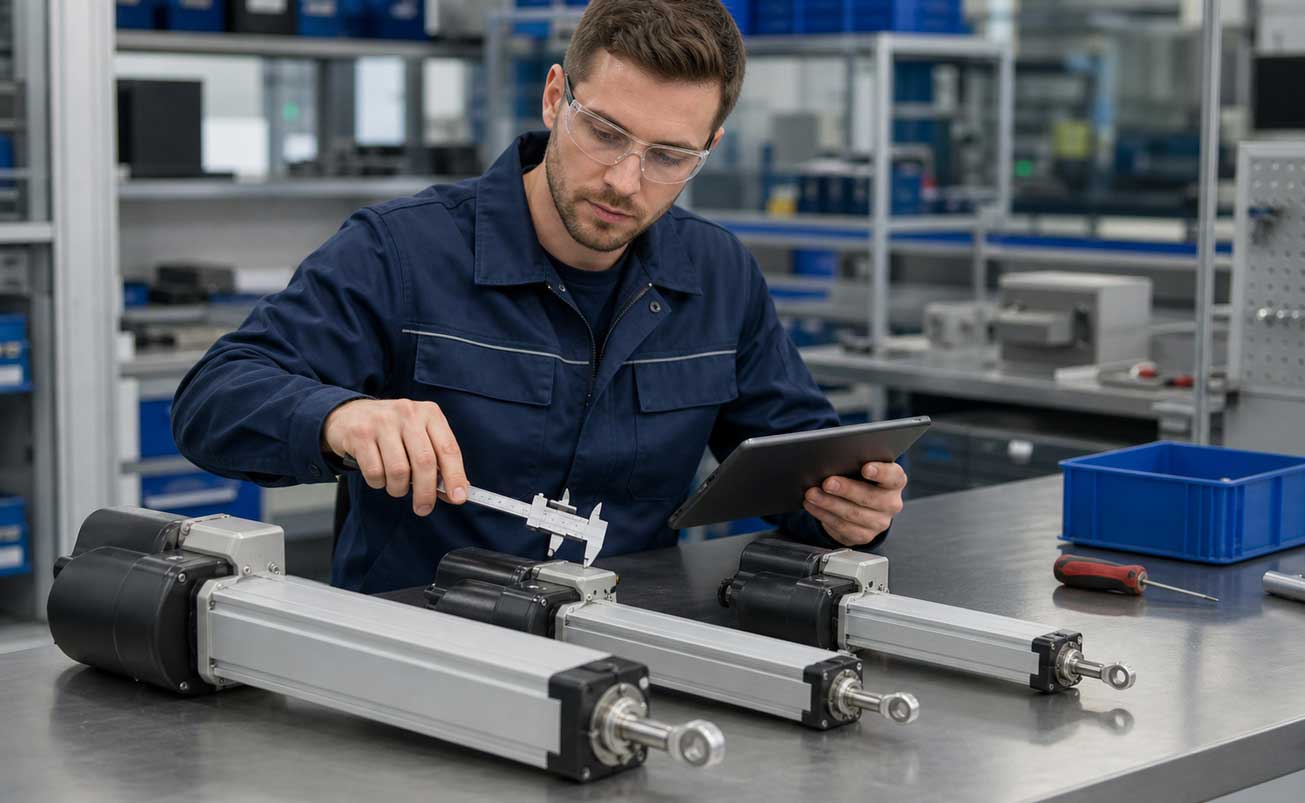
Selecting the right electric linear actuator is essential for achieving accurate, reliable, and efficient motion. The actuator must match the application’s load, stroke, speed, duty cycle, mounting arrangement, operating environment, and control requirements. An undersized actuator may fail prematurely, while an oversized model can increase cost, power consumption, and installation space.
The best actuator is not simply the most powerful one—it is the actuator correctly matched to the application.
AXOVIX Engineering Team
Start With Your Motion Requirements
Begin by defining exactly what the actuator must accomplish. Calculate the maximum load, required travel distance, operating speed, cycle frequency, and available installation space. Include a suitable safety margin for friction, acceleration, vibration, and unexpected loads.
- Calculate the maximum dynamic and static load
- Measure the required stroke length
- Define the desired operating speed
- Confirm available installation space
- Evaluate the required duty cycle
- Determine positioning accuracy and repeatability
- Review environmental operating conditions
- Identify control and feedback requirements
These specifications should be evaluated together. Increasing speed, load, or duty cycle may affect the required motor, screw mechanism, actuator size, power consumption, and expected operational life.
Consider Precision, Mounting and Environment
Applications requiring accurate positioning may need feedback sensors, encoders, ball screw mechanisms, guided actuators, or servo control. Correct mounting is equally important because misalignment and excessive side loading can create uneven wear and reduce actuator life.



The operating environment must also be considered. Dust, moisture, chemicals, vibration, temperature variation, and outdoor exposure can affect the actuator’s materials, sealing, lubrication, and protection requirements.
Choose the Appropriate Actuator Type
Different actuator designs support different motion requirements. AXR rod actuators provide dependable general-purpose linear movement. AXS slider actuators offer compact motion through an integrated carriage. AXG guided actuators provide additional stability for side-load applications, while AXH heavy-duty actuators are intended for demanding forces and operating conditions.
The control system should also match the application. A basic mechanism may require only extend-and-retract operation, while advanced machinery may need adjustable speed, programmable positions, limit switches, encoders, sensors, or PLC integration.
Make the Final Selection
The correct electric linear actuator should satisfy the complete application—not only one specification. Load, stroke, speed, duty cycle, precision, environment, mounting, and control requirements should be reviewed as one motion system.
AXOVIX provides engineering support to help customers evaluate their application and select an actuator configuration that delivers precise movement, dependable operation, and long service life.